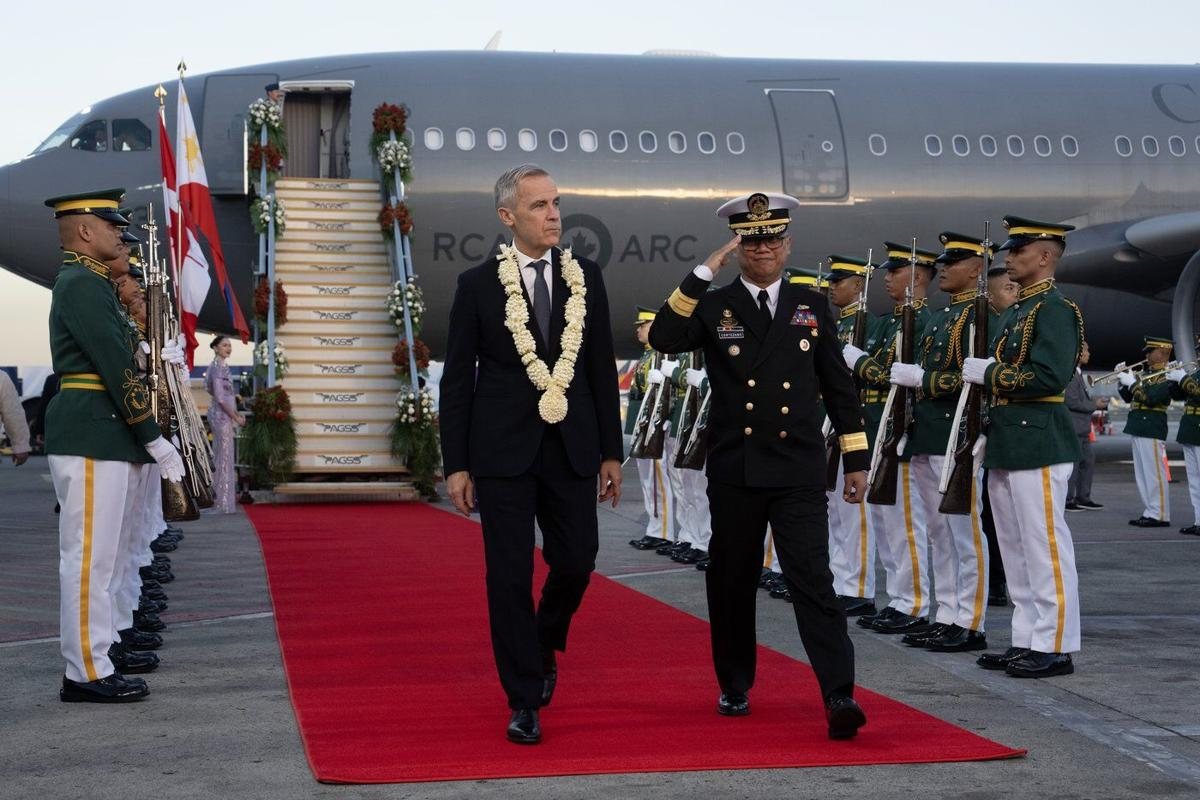
Prime Minister Mark Carney arrived in Manila, the Philippines, early on Saturday to attend an ASEAN summit, with the aim of finalizing a trade agreement with the Philippines and advancing a broader trade deal with the Association of Southeast Asian Nations. He is scheduled to meet President Ferdinand Marcos Jr. later the same day.
The summit brings together 20 heads of government along with outside guests. Among them are U.S. President Donald Trump and Brazil's Lula. The ASEAN bloc counts nearly 700 million people, making it a significant market for Canadian exporters seeking to diversify beyond the United States. The meetings give Carney a direct opportunity to press Canada's case with leaders across the region in a single venue.
Trade between Canada and the ASEAN bloc reached $52.3 billion last year, roughly a fifth higher than the year before. Canada-Philippines merchandise trade alone totalled $3.4 billion in 2025. Canadian exports to the Philippines include ores, meat, cereals, fertilizers and aircraft, while Canada imports cooking oils, leather and rubber products from the Philippines. Carney has set a goal of doubling Canada's non-U.S. exports by 2035, and the Philippine agreement is one of the concrete steps toward that target.
Canada-Philippines trade talks date back to 2015, but Carney and Marcos revived them about a year ago. Last summer the two countries signed a strategic partnership covering labour mobility and climate resilience. That partnership set the stage for the trade agreement now being pursued, and it places economic cooperation alongside commitments on workers and on climate adaptation.
The Manila stop is part of a wider itinerary. Carney recently met European leaders in Ireland, where he pressed the European Union to ratify the Canada-EU trade deal. The trip also includes a summit in Phnom Penh, Cambodia. At the APEC meetings, Carney planned to raise foreign interference with Chinese President Xi Jinping, placing the Asian leg of the journey alongside the European one as part of a single effort to broaden Canada's international partnerships.
Critics have argued that Carney's focus has been on Europe rather than Asia. His approach is also narrower than that of his predecessor, Justin Trudeau, concentrating on trade and defence. Defence cooperation includes participation in Taiwan Strait naval drills and assistance in spotting Chinese vessels. Canada has also appointed a senior defence attaché for the Indo-Pacific region, a post that reflects the growing weight of defence work in the relationship.
ASEAN members tend to view security more broadly, encompassing climate and economic stability. An expert has warned that Canada's narrow sector focus could stall the wider relationship if it is not matched by engagement on those wider concerns. Whether the Philippines agreement and the broader ASEAN talks advance will be watched closely as the summit proceeds, and the outcome will show how far Canada's sectoral approach can take it in a region that values a wider agenda.
18